
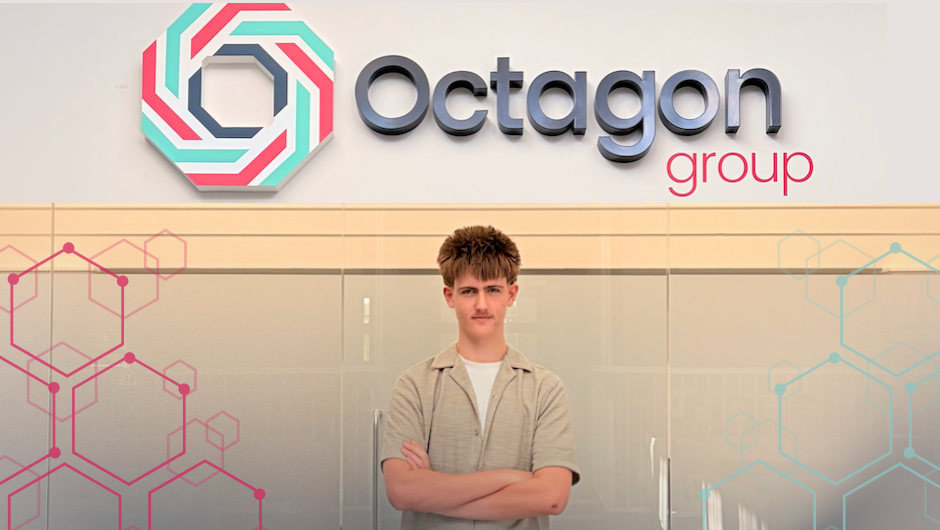
Before I started at Octagon Group, I thought I knew roughly what an internship would look like. I expected small, self-contained tasks on the edge of the real work, almost useful enough to keep me busy, but nothing the business would miss if I got it wrong. I assumed I would spend a few months watching how a company runs from the outside and leave with a line on my CV. Apparently, I was wrong…
From the first day, I was given real responsibility and trusted to work on things that genuinely mattered to the business and its operations. My internship work spanned two sides of development, web and software, and rather than throwaway training exercises, these were projects the team needed and would leave a lasting impact past my short-term position.
The largest was assisting in rebuilding the internal analytics platform. Octagon’s recruitment data lived in RecruitCRM but was difficult to report on, so I built and improved on a pipeline that pulls it through the RecruitCRM API into a Supabase (PostgreSQL) database and out into Looker Studio dashboards. The part I am most proud of was auditing and rebuilding the nine SQL reporting views the managers rely on, aligning each one to a written brief so the numbers they saw were the numbers they had asked for.
On the web side, I assisted in the development of the website and created a geo-redirect plugin for the company’s global site that routes UK and international visitors to the right version of each page using Cloudflare’s country headers, and I ran the migration of the site across domains. Getting the opportunity to work in a production environment where my mistakes had real implications added a higher level of care and perspective to my work.
Not everything went smoothly, and that turned out to be the most valuable part. Early on I noticed the reporting was quietly missing data: some records simply were not showing up. Tracing it back, the cause was orphaned job slugs, a mismatch upstream that broke the link between records. It was the kind of bug that stays invisible until you go looking, and fixing it taught me to distrust a clean-looking dashboard until I have checked what sits underneath it. My SQL went from something I knew a bit of to something I now use to build and debug real reporting infrastructure.
What surprised me most was how much a recruitment business runs on data about people, companies and industries; and how much difference you can make simply by getting that data cleaner and easier to see. I had thought of recruitment as a people business first; I came away realising the people work only scales when the information behind it is trustworthy.
The moment it all clicked was the knowledge that a dashboard I had built and used to answer a real question about the business had become genuinely useful to someone else, rather than another task I had ticked off a list.
Working alongside different members of the team across non-technical and technical backgrounds was also different from what I had expected. I had imagined a formal, corporate and over-serious environment; what I found was far more relaxed, with less pressure and much more trust, which lets people work in the way that suits them best. I assumed that would mean less got done. The opposite was true, feeling comfortable and trusted made me more productive and far more willing to take on things I had never done before with confidence.
That is the part that has changed how I think about work. I used to see an experience like this as one-and-done. Now I care much more about doing work that lasts and about working somewhere that trusts people to break production from day one. I am leaving with sharper technical skills, including SQL, data pipelines and WordPress infrastructure, but more importantly, with a clearer sense of the kind of place I want to build a career in. As I hopefully move more towards an engineering, and eventually robotics and autonomous systems background, I will carry the habit I picked up here: understand how your piece fits the bigger goal, then build something people can rely on.